|
SASC-NG
DVBSoftCAM
|
|
SASC-NG
DVBSoftCAM
|
#include <skins.h>
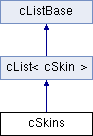
 Inheritance diagram for cSkins:
Public Member Functions | |
| cSkins (void) | |
| ~cSkins () | |
| bool | SetCurrent (const char *Name=NULL) |
| cSkin * | Current (void) |
| Returns a pointer to the current skin. | |
| bool | IsOpen (void) |
| Returns true if there is currently a skin display object active. | |
| eKeys | Message (eMessageType Type, const char *s, int Seconds=0) |
| int | QueueMessage (eMessageType Type, const char *s, int Seconds=0, int Timeout=0) |
| void | ProcessQueuedMessages (void) |
| Processes the first queued message, if any. | |
| void | Flush (void) |
| Flushes the currently active cSkinDisplay, if any. | |
| virtual void | Clear (void) |
| Free up all registered skins. | |
| cSkins::cSkins | ( | void | ) |
Definition at line 49 of file vdrcompat.cpp.
{}
| cSkins::~cSkins | ( | ) |
Definition at line 50 of file vdrcompat.cpp.
{}
| void cSkins::Clear | ( | void | ) | [virtual] |
Free up all registered skins.
Reimplemented from cListBase.
Definition at line 52 of file vdrcompat.cpp.
{}
| cSkin* cSkins::Current | ( | void | ) | [inline] |
| void cSkins::Flush | ( | void | ) |
Flushes the currently active cSkinDisplay, if any.
| bool cSkins::IsOpen | ( | void | ) | [inline] |
| eKeys cSkins::Message | ( | eMessageType | Type, |
| const char * | s, | ||
| int | Seconds = 0 |
||
| ) |
Displays the given message, either through a currently visible display object that is capable of doing so, or by creating a temporary cSkinDisplayMessage object. The return value is the key pressed by the user. If no user input has been received within Seconds (the default value of 0 results in the value defined for "Message time" in the setup), kNone will be returned.
Definition at line 51 of file vdrcompat.cpp.
References kNone.
Referenced by cMenuSetupSc::ProcessKey().
{ return kNone;}
| void cSkins::ProcessQueuedMessages | ( | void | ) |
Processes the first queued message, if any.
| int cSkins::QueueMessage | ( | eMessageType | Type, |
| const char * | s, | ||
| int | Seconds = 0, |
||
| int | Timeout = 0 |
||
| ) |
Like Message(), but this function may be called from a background thread. The given message is put into a queue and the main program loop will display it as soon as this is suitable. If Timeout is 0, QueueMessage() returns immediately and the return value will be kNone. If a positive Timeout is given, the thread will wait at most the given number of seconds for the message to be actually displayed (note that the user may currently be doing something that doesn't allow for queued messages to be displayed immediately). If the timeout expires and the message hasn't been displayed yet, the return value is -1 and the message will be removed from the queue without being displayed. Positive values of Timeout are only allowed for background threads. If QueueMessage() is called from the foreground thread with a Timeout greater than 0, the call is ignored and nothing is displayed. Queued messages will be displayed in the sequence they have been put into the queue, so messages from different threads may appear mingled. If a particular thread queues a message with a Timeout of -1, and the previous message from the same thread also had a Timeout of -1, only the last message will be displayed. This can be used for progress displays, where only the most recent message is actually important. Type may only be mtInfo, mtWarning or mtError. A call with mtStatus will be ignored. A call with an empty message from a background thread removes all queued messages from the calling thread. A call with an empty message from the main thread will be ignored.
Referenced by cScPlugin::MainThreadHook().
| bool cSkins::SetCurrent | ( | const char * | Name = NULL | ) |
Sets the current skin to the one indicated by name. If no such skin can be found, the first one will be used.
 1.7.3
1.7.3